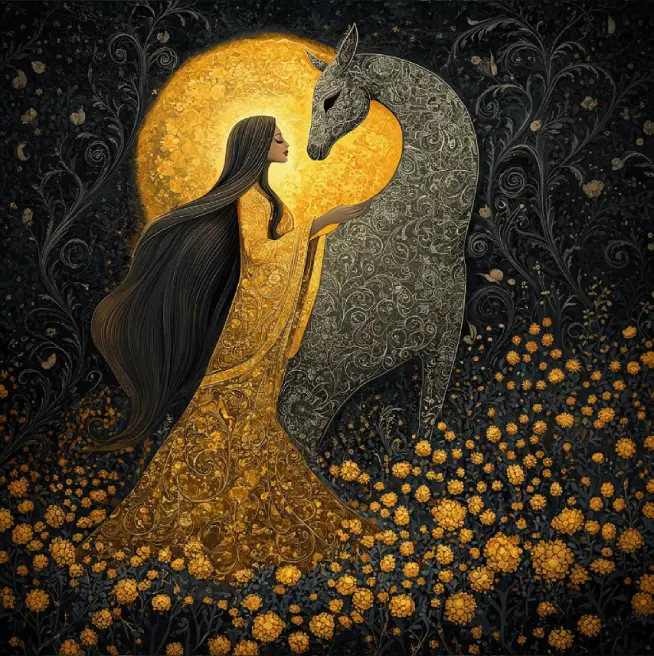

Anyone who has lived closely with an animal knows the experience.
A quality of attention that arrives without words. A sense of being genuinely seen — not evaluated, not judged, simply met. The dog that moves to lie beside you precisely when the weight of something becomes difficult to carry alone. The horse that shifts its posture in response to something in your nervous system that you had not yet consciously registered. The cat that arrives and settles at the moment when stillness finally becomes possible.
These exchanges are real. Something is passing between species that language does not organize and that the rational mind tends to explain away before it has been genuinely examined.
What Animals Register
Animals navigate their social and physical environments primarily through channels that human culture has progressively marginalized — somatic signals, postural cues, subtle shifts in autonomic state, the quality of presence that a body carries before it speaks or acts.
Research in animal cognition has demonstrated that many species read human emotional states with remarkable precision. Dogs, for instance, respond differentially to human cortisol levels, heart rate variability, and postural micro-expressions — physiological signals that their human companions are frequently unaware of themselves (Buttner et al., 2015; Handlin et al., 2011). Horses, whose survival as prey animals depends on continuous environmental scanning, demonstrate sensitivity to human autonomic states that has become the basis of established therapeutic and coaching practices (McCraty, 2003).
What animals are reading, in many cases, is the body’s actual state — beneath the narrative the mind is constructing about it. They respond to what is present rather than to what is being performed or communicated intentionally. This is one reason why contact with animals so often produces a quality of recognition — a sense of being known at a level that social interaction rarely reaches.
Imagination as an Interspecies Bridge
To turn inward toward an animal and sense its presence is not necessarily to step outside reason, but to engage a deeper layer of perception. The human nervous system is exquisitely attuned to relational signals (Porges, 2011; Decety & Jackson, 2004). What appears as imagination may sometimes be the psyche’s way of translating subtle attunement into symbolic form (Damasio, 1999; Gendlin, 1978).
Science has not yet fully mapped this territory — but neither has it closed it. The frontier lies in understanding how empathy, perception, and imagery intertwine.
And yet the practice has a long history. Indigenous traditions across cultures have used imaginative and altered-state practices to enter into relationship with the consciousness of other species — not as metaphor, but as a genuine mode of knowing (Ingerman, 1991). Contemporary animal communication practitioners describe a similar process — a quality of inward attention directed toward the animal, a receptivity to what arises in response, a translation of imagistic and somatic impressions into communicable form.
From a neuroscientific perspective, what this process engages is the same integrative capacity that underlies all imagination-based knowing. The default mode network draws together somatic signals, pattern recognition, and information that has been registered below the threshold of conscious awareness, synthesizing it into imagistic and emotional form (Buckner et al., 2008). When attention is directed toward an animal with genuine receptivity, the brain integrates what it has registered about that animal’s state — through observation, through postural attunement, through the subtle mirroring that occurs in the presence of another living body — and offers it back in the form most natural to inner knowing: image, sensation, impression, felt sense.
Whether this process draws only on what the nervous system has already registered through ordinary channels, or whether it opens into something that exceeds those channels, remains genuinely open. What the practice consistently produces is information — about the animal’s physical state, its emotional quality, its relational history — that attentive practitioners report with a specificity that warrants serious consideration.
The Quality of Attention That Makes It Possible
What animal communication through imagination requires is a particular quality of inward attention — receptive rather than projective, open rather than interpretive, willing to receive what arrives rather than to construct what seems plausible.
This is the same quality that imagination-based inner work cultivates more generally. The capacity to turn attention inward and wait — without demanding, without filling the space prematurely with familiar content — develops through practice. As it develops, the range of what becomes available through that attention expands.
With animals, this quality of attention also requires a particular kind of humility. The temptation to project — to fill the animal’s imagined communication with what we expect or wish to hear — is real and requires honest self-examination. The discipline of the practice lies in learning to distinguish between what arrives and what the mind constructs — a distinction that becomes more reliable with experience and more difficult to fake with honesty.
A Different Kind of Knowing
Contact with animals — physical or imaginative — tends to return something that social life among humans frequently obscures. A quality of presence that the body recognizes. A mode of communication that bypasses performance and reaches what is actually there.
Imagination, approached with genuine receptivity, extends the reach of that contact. The animal that is no longer physically present can still be approached inwardly. The animal whose communication the conscious mind did not register in the moment can be returned to in imagination, with more stillness and more attention than the original encounter allowed.
What arrives through this attention is worth receiving with care. Animals have been communicating across the boundaries of species for far longer than human language has existed. Imagination is one of the ways we remember how to listen.
Further exploration
How intuitive perception and imagination intersect from a neuropsychological perspective is explored in: Spirituality & Intuition Through Imagination: The Neuroscience of Inner Guidance