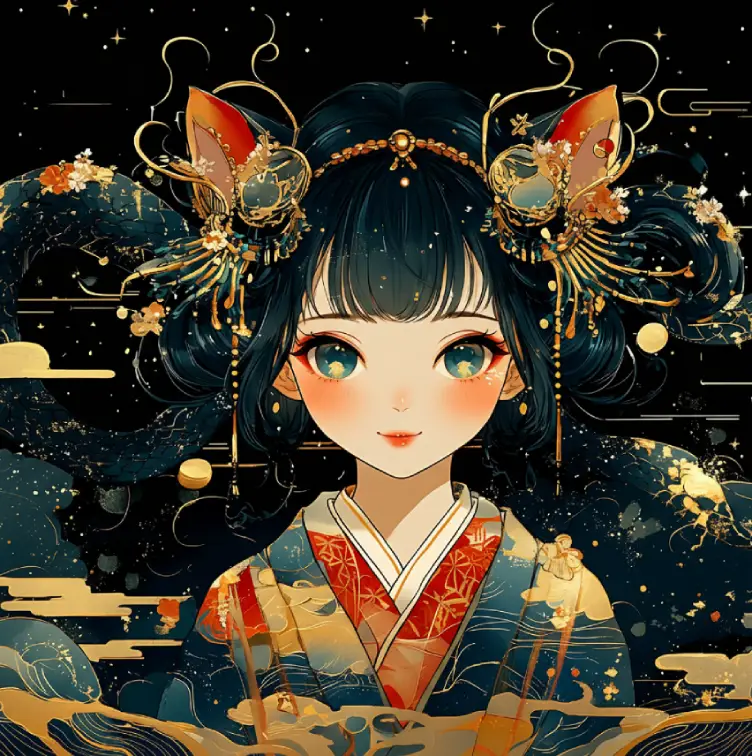

There is a moment many people recognize — sitting with an animated character whose struggle feels uncomfortably familiar. The orphaned hero who cannot ask for help. The healer who saves everyone but themselves. The wanderer who belongs nowhere and everywhere at once.
Something tightens. Or loosens. The feeling arrives before the analysis does.
This is not coincidence. And it is not escapism. It is imagination doing what it has always done — using symbolic form to make visible what direct confrontation cannot reach.
When the Fictional Feels More Real Than the Real
In 2024, psychiatrist Francesco Panto at Keio University in Tokyo published findings that formalized what many clinicians had been observing for years: patients who struggled to engage with traditional talk therapy — particularly those with social anxiety, trauma histories, or profound withdrawal — could access emotional material far more readily when working through an animated avatar or character identification (Panto, 2024).
The reason is not difficult to understand neurobiologically. Direct eye contact with a therapist, a clinical setting, the expectation of self-disclosure — for many people, particularly those for whom vulnerability has historically meant danger, this configuration activates the threat system before any meaningful work can begin. The body is already defending before the first word is spoken.
An animated character introduces what researchers call a psychological buffer. The material is still present — the pain, the pattern, the frozen belief — but it is held at one remove. That distance is not avoidance. It is the condition under which approach becomes possible.
The Proteus Effect: You Become What You Inhabit
In 2007, psychologists Nick Yee and Jeremy Bailenson described what they called the Proteus Effect — the finding that people’s behavior and self-perception shift to conform to the digital avatar they inhabit or identify with (Yee & Bailenson, 2007). Taller avatars increased confidence in negotiation. Older avatars shifted attitudes toward retirement saving. Heroic avatars increased prosocial behavior.
The mechanism is straightforward: the brain does not maintain a clean separation between self and representation. When we inhabit or strongly identify with an image — digital, imaginal, or symbolic — the nervous system begins to organize around that image as if it were real.
This is the same principle at work in every imagination-based therapeutic method. The compassionate figure in CFT. The Self in IFS. The dream figure in active imagination. The difference with anime avatars is that the images come pre-loaded with emotional and narrative resonance — shared, refined across millions of viewers, and already alive in the inner world of the person before the therapeutic encounter begins.
Anime as a Contemporary Archive of Archetypes
Jung described archetypes as universal patterns that structure inner experience — the Hero, the Shadow, the Mentor, the Wounded Healer, the Eternal Wanderer (Jung, 1959). He found them in myths, fairytales, and dreams. He would have found them immediately in anime.
What makes anime particularly potent as psychological material is the precision of its emotional vocabulary. Stylized, exaggerated expressions — the visual language of manga and animation — communicate affect with a directness that naturalistic representation often cannot match. Research on alexithymia, the difficulty in identifying and naming one’s own emotional states, suggests that exaggerated emotional representation can help people recognize and label internal states they would otherwise struggle to articulate (Ennis, 2021).
Put simply: sometimes a character’s face shows you what your own body has been carrying without words.
This is not superficial. The limbic system — the brain’s emotional processing center — responds to symbolic and representational stimuli directly, without waiting for cortical interpretation. An image lands before it is understood. Anime operates in that gap.
The Hero’s Journey as Inner Map
Joseph Campbell’s mapping of the monomyth — the Hero’s Journey shared across cultures and centuries — describes a pattern that anime narratives follow with remarkable consistency (Campbell, 1949). Departure from the known world. Trials in unfamiliar territory. Transformation. Return with something that could not have been brought back any other way.
What makes this psychologically significant is not the narrative structure itself but what identification with it makes possible.
When someone who has been living as the victim of their circumstances — of their history, their diagnosis, their relationships — begins to recognize their experience as a Hero’s Journey rather than a punishment, something reorganizes. Not because the story is false consolation, but because the reframing is neurobiologically real. The same events, held in a different narrative container, produce different physiological and emotional responses. The brain’s predictive models update. The future begins to look different because the past has been re-encoded.
This is narrative reframing — not as positive thinking, but as a genuine shift in how experience is organized and anticipated.
Projective Identification: The Safer Path In
One of the most clinically useful aspects of character-based work is what psychoanalysts call projective identification — the process by which we place our own internal states, conflicts, or desires into an external figure and then relate to them there (Klein, 1946).
In practice this looks like: I am not angry. But that character’s rage feels completely justified.
Or: I don’t know why I cry at that scene. She’s just a cartoon.
The emotion is real. The displacement is the mechanism that makes it accessible. By analyzing a character’s pain before acknowledging our own, we allow a gradual thawing of material that direct confrontation would freeze further (Ennis, 2021). The fictional container holds what the personal container currently cannot.
This is not a workaround or a lesser form of therapeutic engagement. It is how imagination has always worked — in myth, in ritual, in dreamwork, in the stories people tell about themselves in the third person when the first person is still too close.
Working with the Anime Mirror
The clinical and self-exploratory applications of this are straightforward, though not always simple.
Character identification — Which characters have moved you most strongly? Where did you feel recognition, envy, grief, or sudden inexplicable loyalty? These responses are data. They point toward material that is active in the inner world, whether or not it has been consciously acknowledged.
Narrative mapping — Where are you in the arc? Departure, trial, transformation, return? Not as a way of forcing meaning onto experience, but as a way of locating yourself in a process that has direction — even when the present moment feels like stasis.
Avatar work — Who would you be if you could choose? Not as wish fulfillment, but as a question about which qualities are longed for, which aspects of self feel exiled, which capacities are waiting to be recognized. The Proteus Effect suggests that inhabiting that image, even imaginally, begins to change something real (Yee & Bailenson, 2007).
Shadow recognition — Which characters do you find yourself judging most harshly? Contempt and moral disgust are often reliable indicators of disowned material (Jung, 1959). The villain who gets under your skin is worth sitting with.
The Screen as Inner World
There is a cultural tendency to dismiss engagement with animated or fictional characters as trivial — as something to be grown out of, as evidence of an inability to face reality directly.
The evidence suggests the opposite. The capacity to be genuinely moved by symbolic and fictional material — to feel, through a character, what cannot yet be felt directly — is not a failure of development. It is imagination functioning as it was designed to: as the interface between the inner world and the territory that has not yet become conscious.
Anime is simply the contemporary form of what myth and fairytale have always provided. The images are newer. The archetypes are not.
Curious about the methods that work directly with symbolic imagery and character dialogue? Active Imagination, Inner Child Work, and IFS all share the same underlying logic — engaging the figures that arise in imagination as real interlocutors rather than mere projections.