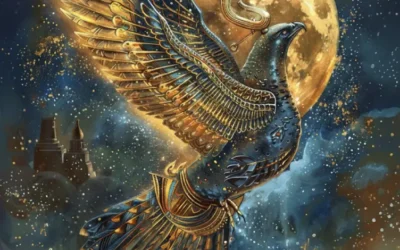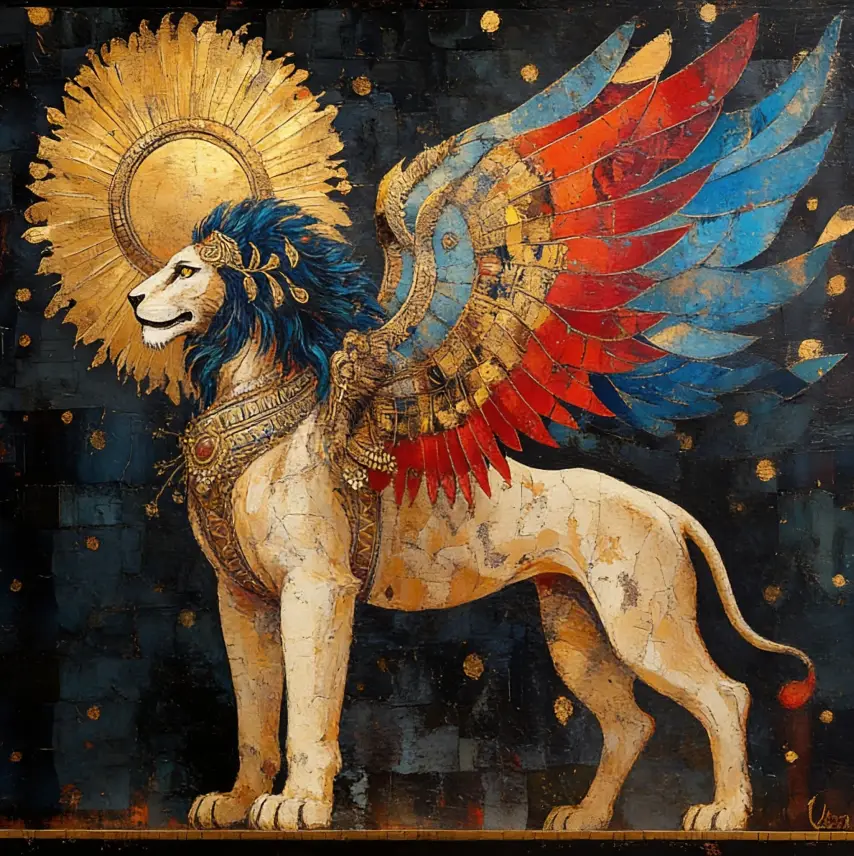

When an animal appears in a dream or in the imagination, something shifts before understanding arrives.
The body responds first. A quickening, a stilling, a sudden alertness or softening — something in the nervous system recognizes what has appeared and responds to it directly, before the mind has had time to categorize or interpret. The animal arrives and something ancient in us answers.
This immediacy is not accidental. It is biological.
Why Animals Carry Such Force
The human nervous system evolved over millions of years in continuous relationship with other animals — as predator, as prey, as companion, as threat. Long before language existed, long before symbolic thought of any complexity was available, the capacity to read an animal’s posture, movement, and intention was survival-critical. Neural systems dedicated to this reading developed deep in the evolutionary history of the brain, in structures that precede the cortex by hundreds of millions of years.
These systems remain active. When an animal appears — in external reality or in inner imagery — they respond before the cortical processing that generates conscious thought has had time to complete. The amygdala, the superior colliculus, the subcortical threat-detection pathways — all of these register the animal’s presence and generate a somatic response before awareness arrives to name what is happening (LeDoux, 1996; Öhman & Mineka, 2001).
This is why an animal in imagination carries force that an abstract concept cannot match. The image of a wolf activates something in the body. The word aggression does not — at least not with the same speed, the same directness, the same somatic immediacy. The animal bypasses the verbal mind and speaks to something older.
Animals as Carriers of Instinctual States
In Jungian psychology, animals in inner imagery are understood as carriers of instinctual energy — aspects of the psyche that operate below the level of conscious intention, organizing drives, impulses, and emotional states that the more socialized layers of the self have learned to manage, suppress, or simply ignore (Jung, 1969).
The animal that appears carries information about an instinctual state that is currently active — its quality, its intensity, its direction. A predator may carry something about aggression or power that has found no conscious outlet. A wounded animal may carry something about vulnerability that has been protected against. A wild animal held in captivity may reflect something about vitality that has been contained beyond its tolerance.
What matters clinically and therapeutically is the relationship between the person and the animal that appears. The emotional response — fear, fascination, tenderness, revulsion — reveals the relationship between the conscious self and the instinctual material the animal is carrying. That relationship can be explored, developed, and changed through imaginative engagement.
Meeting the Animal in Imagination
Active imagination with an animal figure follows the same principles as any imaginal dialogue — the image is approached with curiosity, engaged as a presence with something to communicate, and allowed to develop under sustained attention.
But animal imagery often requires a particular quality of approach. The verbal, interpretive mind tends to move too quickly in relation to what animals carry. Analysis distances. The animal responds to something more like the quality of attention one brings to an actual animal encounter — patient, present, attuned to movement and gesture rather than rushing toward meaning.
When this quality of attention is brought to an animal figure in imagination, the encounter often develops in unexpected directions. The threatening animal, approached with steadiness rather than flight, may reveal what it is protecting. The wounded animal, met with genuine care, may show what it needs. The wild animal, given space rather than containment, may demonstrate a quality of energy that the self has been holding at a distance.
What emerges through this engagement is rarely what the analytical mind would have predicted. The animal carries something that exceeds what deliberate construction could have produced — because it is arising from the instinctual layers of the psyche, which operate according to their own intelligence.
The Bridge Between Instinct and Awareness
Animals in inner imagery serve as a bridge between the instinctual and the conscious — between the layers of the nervous system that organize drives, threat responses, and somatic states, and the awareness that can receive, relate to, and eventually integrate what those layers are carrying.
This bridge is significant because instinctual material, left unmet, does not simply remain inert. It presses toward expression — in the body, in behavior, in the quality of reactivity that surfaces under stress or relational activation. When it is met in imagination — when the animal that carries it is approached with the attention it requires — something of that pressure can begin to move, to differentiate, to find a form of expression that consciousness can work with.
The animal knows what the mind is still learning to say. Imagination is the space in which they can finally meet.
Further exploration
How symbolic figures from culture and fiction become mirrors for the inner world is explored in: The Anime Mirror: How Animated Characters Become Doorways to the Inner World