

How Do We Change Ourselves? And Why Knowing Why Is Not Always Enough
When we want to change, our first impulse is usually to understand. We analyze what happened, look for patterns, and put our reasons into words. Through language, we create a story that makes sense. We gain insight.
This is change through Narrative Restructuring. It changes how we interpret our lives. Sometimes, this is enough—a new understanding can lead to new behavior.
But most people face a frustrating paradox:
You know exactly why you react the way you do—and yet, you keep reacting the same way.
This isn’t a lack of willpower or intelligence. It’s because your brain encodes experience on two completely different levels.
The Two Levels of Transformation
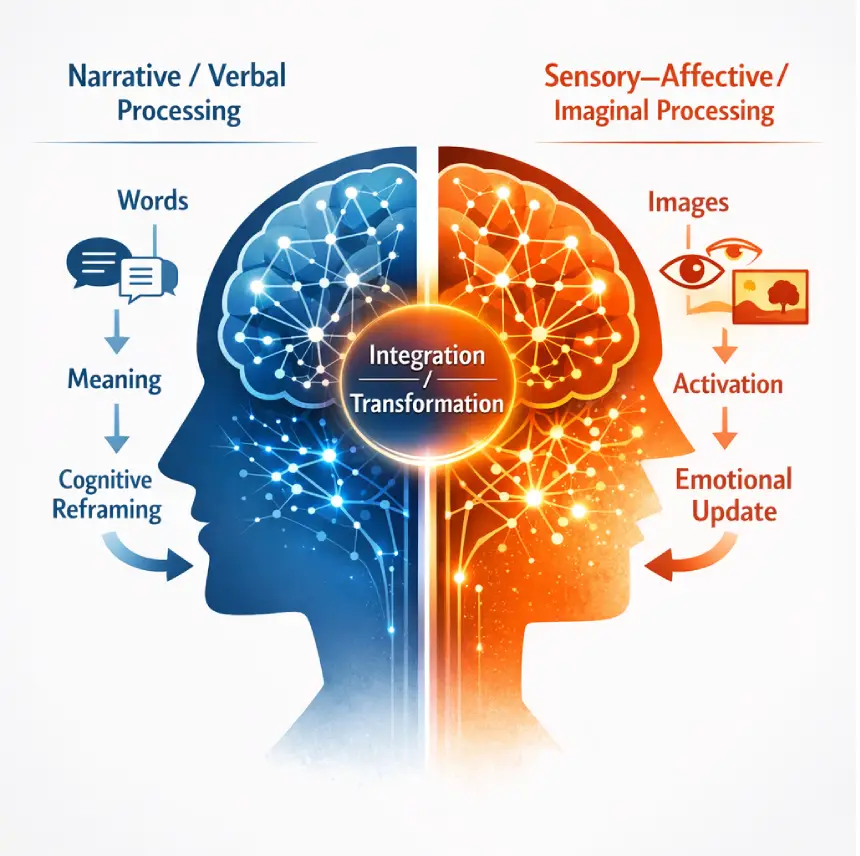
1. The Narrative Level (The Story) This level is about language and concepts. Through talking and reflection, you reorganize your life story. You identify themes, causes, and beliefs.
-
The Result: You change how you think about your situation.
2. The Sensory–Affective Level (The Feeling) Beneath your words lies a different kind of code. Emotional learning is stored as images, bodily sensations, and automatic reactions. This is where your “gut responses” live.
-
The Result: You change how the experience feels—not just how it is understood.
Key Distinction
Insight reorganizes meaning. Imagination reorganizes encoding. Understanding your story can shift perspective. But emotional memory is stored as images, sensations, and anticipatory patterns. Lasting change occurs when those internal representations update — not only the narrative.
When Has Change Actually Occurred?
The Neuropsychology of Transformation
We often use broad words like “growth” or “healing.” But in neuroscience, transformation has a very specific meaning: it is the reorganization of your internal maps.
Your brain uses internal “maps” to navigate life. These are networks of sensory memories, emotional associations, and expectations that tell you what will happen next. Most of the time, these maps guide your behavior before you even realize it. They are “predictive systems”—your brain’s way of constantly guessing the future based on the past (Friston, 2010).
The good news? These maps aren’t permanent. Research shows that when an emotional memory is reactivated, it enters a “plastic” or flexible state (Nader & Hardt, 2009). This is the window of opportunity where it can be updated.
Transformation is an Upgrade, Not Just New Info
True change isn’t about learning a new fact; it’s about updating how your experience is structured. In practice, this looks like three specific shifts:
-
Regulating Reactions: An old emotional trigger is replaced by a calmer response.
-
Example: Instead of your heart racing when a boss gives feedback, you feel a steady sense of curiosity.
-
-
Neutralizing Memories: A memory is “reconsolidated” (saved again) in a new form that no longer carries the same painful sting.
-
Example: You remember a difficult breakup, but the physical “gut-punch” feeling is gone; it’s now just a story from your past.
-
-
Updating Expectations: Your brain’s predictive model changes what it expects from the world.
-
Example: Instead of walking into a party expecting to be judged, your “internal map” defaults to expecting a friendly connection.
-
Why “Knowing” Isn’t Enough
This is why insight alone often fails. You can intellectually understand your history, but if the underlying “map” remains the same, your old emotional response will keep firing.
Transformation happens when that internal structure becomes flexible and reorganizes. It isn’t just a shift in how you see things—it’s a shift in how your brain encodes and anticipates life.
What Is Needed for Change to Occur?
If transformation is about reorganizing our “inner world,” the real question is simple: how does that shift actually happen?
We know that change requires more than a good explanation. It requires that the pattern we want to change is actually activated.
Our emotional memories are stored in a language of feelings, sensations, and images—not just in words. That’s why you can understand exactly why you have a certain fear, yet your body still reacts as if a threat were present. Researchers describe this as the vital difference between “narrative understanding” (the story you tell) and “embodied encoding” (how the memory is actually locked in your nervous system).
The “Open Window” of Change
Science suggests that for an old emotional pattern to change, it must first be brought into your awareness in an experiential way. According to research on memory reconsolidation, emotional memories become temporarily flexible—or “plastic”—only when they are reactivated and paired with new information.
Without activation, there is no update.
In simple terms: if we don’t “touch” the pattern, we can’t change it. This is why the phrase “feel it to heal it” actually captures a scientific truth. Emotional learning shifts most reliably when the feeling is present—and when something new and unexpected happens while that feeling is active.
The Three Steps to Re-wiring
For change to take root, three things must happen together:
- Activation: The original feeling, image, or bodily reaction becomes present enough to work with.
- New Input: Your system encounters something different from what it expected. In predictive processing theory, this is called a “mismatch” between expectation and experience.
- Integration: The new experience stabilizes. It starts to feel “real,” and your body accepts the update.
Words and Images: A Powerful Partnership
Talking is powerful. It helps us understand our story and supports the final step of integration.
Imagination, however, is often the key to activation. Because imagined experiences use many of the same neural circuits as real perception, they can evoke emotions with surprising intensity.
This explains why some insights stay “stuck in your head,” while others feel like something deep inside has truly shifted. Real change isn’t just about learning something new; it’s about updating the entire system. And that system updates most effectively when we both understand the shift and experience it.
Key Distinction
Change requires activation. Without activation, there is no update. Emotional memory only becomes flexible when it is reactivated. While talking may describe a pattern, imagery brings it online — where it can actually change.
Two Pathways to Change: Verbal Reflection and Imaginative Engagement
Research is clear: meaningful change isn’t just about the technique you use. What actually matters is how deeply a new insight becomes emotionally integrated into your world (Lambert & Barley, 2001; Norcross & Lambert, 2019).
But how do we get there? There are two main doorways:
1. When Words Lead the Way
It’s not the conversation itself that transforms us, but the “aha!” moment that follows. Verbal reflection works when insight moves beyond just being a clever thought and starts to influence how you actually feel and act.
This happens best in a space of psychological safety. When you feel secure, you can explore vulnerable territory and let new interpretations reshape your life.
-
The logic: Conversation reorganizes your meaning.
-
The result: When meaning shifts deeply enough, your emotions often follow.
2. When Imagination Takes the Lead
Imagination enters the system through a different door. Because mental imagery activates your brain’s sensory systems as if the experience were happening for real (Pearson et al., 2015), it creates an immediate emotional spark.
This is where the “magic” happens. Imaginative work is effective when:
-
Presence: The internal image or feeling becomes vivid enough to “touch.”
-
New Input: You introduce something new—like compassion or safety—while the old pattern is active.
-
Stability: The new experience is repeated until it feels like your new “normal.”
Why this matters: Research suggests that imagery often triggers a stronger emotional response than words alone (Holmes & Mathews, 2005; Ji et al., 2016). When you pair that activation with a new experience, your brain’s emotional patterns can finally begin to reorganize.
Limitations: Why Neither Path Is Enough on Its Own
No single pathway guarantees transformation. Both verbal reflection and imagination have unique strengths—but they also have blind spots.
When Words Are Not Enough
Verbal processing is excellent for creating a clear story and finding meaning. However, since emotional memories are often locked in sensory networks, logic alone cannot always reach and update those representations (Holmes & Mathews, 2005).
-
The Paradox: You can explain a fear or analyze a relationship pattern perfectly, while your underlying physiological response remains unchanged. In these cases, reflection strengthens your story but doesn’t alter the “embodied encoding.”
-
The Risk of Intellectualization: It is easy to stay at a “safe” reflective distance rather than engaging the emotional material itself. If this activation is insufficient, the brain’s ability to rewire—its plasticity—remains limited (Nader & Hardt, 2009).
When Imagination Misses the Mark
Imagination is powerful because it recruits neural systems similar to actual perception, triggering intense emotional states (Pearson et al., 2015). But power without direction can be risky.
-
Reinforcing the Old: If a painful emotional memory is repeatedly reactivated without adding sufficient “novel input,” you might just strengthen the original network instead of updating it.
-
The Missing Mismatch: According to predictive processing theory, change depends on a meaningful “mismatch” between what you expect and what you actually experience (Friston, 2010). Without this mismatch, the system simply rehearses what it already knows.
-
Symbolic Drift: There is a risk of becoming absorbed in imagery without integrating it into a coherent understanding. In these cases, the experience feels intense, but it doesn’t lead to a lasting reorganization of your internal world.
Why Integration Is the Key
Lasting change typically requires coordination between these two pathways:
- Verbal Reflection supports integration and coherence (The “Why”).
- Imaginal Engagement supports activation and modification (The “How”).
Transformation is most reliable when your cognitive clarity and your embodied experience are finally aligned. Neither words nor images are enough alone—they are two halves of the same whole.
Key Distinction
Activation without integration strengthens patterns. Integration without activation leaves them intact. Imagination without regulation can rehearse old patterns. Insight without embodiment leaves emotional encoding unchanged. Transformation requires both.
The Complementary Paths of Talk and Imagination
Talk therapy, at its best, is a powerful catalyst for change. Through dialogue and a secure therapeutic relationship, we gain mirroring, validation, and insight into our lives — factors consistently shown to be central to therapeutic outcome (Lambert & Barley, 2001; Norcross & Lambert, 2019). This process helps us build a coherent narrative of our experiences and strengthens our capacity for reflection.
Yet many people encounter a paradox: they understand the “why” of their struggles intellectually, but their emotional reactions and bodily patterns remain unchanged.
One reason may be that verbal processing tends to engage cognitive reflection more strongly than embodied emotional networks. Deeper emotional learning is often encoded not as language, but as sensory fragments, affective states, and procedural patterns stored in limbic and subcortical systems. Insight alone does not automatically update those networks.
This is where imaginative work offers a complementary path.
The Neuroscience of Imaginative Practice
Imaginative work is often facilitated in a lightly relaxed state with reduced external input — sometimes with closed eyes — allowing internal imagery to become more vivid.
Neuroscientific research shows that mental imagery activates many of the same neural networks involved in real perception (Pearson et al., 2015). Emotional responses also tend to be stronger when individuals imagine emotionally charged content compared to when they process it verbally (Holmes & Mathews, 2005).
Because imagery engages sensory and affective systems directly, internal experiences can feel intensely real. This experiential vividness may be one reason imagery-based interventions can modify emotional responses and memory representations in clinically meaningful ways (Ji et al., 2016).
Rather than merely thinking about change, the nervous system rehearses it.
What Distinguishes the Two Approaches?
In talk therapy, language is the primary tool. We narrate, analyze, reflect, and construct new meaning through dialogue. This approach is particularly powerful when relational safety allows emotions to emerge and insights to integrate.
Imaginative work turns attention inward in a different way. Here, the inner landscape — spontaneous or guided images, symbols, scenes, figures, and bodily felt experiences — becomes the material itself.
Instead of speaking about a fear or memory from a distance, you encounter it directly: You may see it, sense its shape, hear its tone, feel its texture in the body.
In structured forms of imagery work, you can engage with memory images by introducing safety, compassion, new perspective, or symbolic transformation. Rather than only describing the past, you work with the way it is represented internally.
The shift is experiential rather than purely conceptual.
When Imagination Becomes Experientially Potent
Imaginative methods engage your experience in a way that verbal reflection simply cannot. Rather than just describing what happened, you “re-enter” the experience through mental imagery, bodily sensations, and symbols.
In this space, emotional patterns aren’t just something we talk about—they are something we encounter.
The Power of Internal Simulation
Because mental imagery activates the same neural systems involved in real perception and emotion (Pearson et al., 2015), imagined scenes can trigger emotional responses with striking immediacy. In fact, research suggests that imagery-based processing often produces much stronger emotional activation than verbal thought alone (Holmes & Mathews, 2005; Ji et al., 2016).
In practical terms, this looks like:
-
Beyond the Story: You aren’t just describing a memory; you are experiencing it in a new, modified, and safer form.
-
Meeting the Fear: You aren’t just analyzing a fear from a distance; you are encountering its image and its unique “bodily signature.”
-
Neural Rehearsal: You aren’t just planning change conceptually; you are simulating it in rich, sensory detail.
Working with the Code
This capacity for internal simulation allows your emotional “maps” to become accessible in a way that intellectual reflection often misses.
Imaginative engagement doesn’t replace verbal understanding—it expands it. By working directly with how an experience is encoded in your system, it reaches the layers where emotional memory actually lives.
Why Choose Imaginative Work?
For those seeking deeper integration, emotional freedom, or a stronger connection to their own intuition, imagination is an unsurpassed tool.
Whether the goal is healing past wounds or actively manifesting new future possibilities, this work captures complex energies that words struggle to reach. For example, it allows you to:
- Work directly with memory representations
-
Rehearse new emotional responses
-
Develop self-compassion through embodied experience
-
Explore future possibilities in sensory detail
… and more
Crucially, it empowers you with autonomy. This is a skill you can learn to apply yourself, not just in a therapy room. Even a brief, 15-minute self-guided session can be profoundly shifting, training an inner “muscle” that strengthens the more you use it. It offers the opportunity not just to understand change intellectually, but to feel it—in the body, in the sensory image, and in your unfolding reality.
When words are not enough, when intuitive nudges need to be understood, or when you feel called to access a deeper creative power, imagination opens the door. It bridges the gap between thinking and being. It is not “woo-woo”; it is an ancient, time-tested path to greater vitality and profound inner knowing.
Are you ready to try it yourself? In the Explorations section of this site, you will find practical guides and simple starting points to begin navigating your own inner landscape right now.