

Why Your Good Intentions Are Failing
Many of us have been there. You feel the familiar rising tide of stress—the tight chest, the racing thoughts. You remember the advice from a self-help book or therapist, so you try to intervene.
You try to lower the stress by finding soothing images. You speak calming words to yourself, perhaps repeating affirmations like “I am safe, I am calm.” You try to create vivid mental pictures of yourself in better shape, handling the situation perfectly. Sometimes, it works like a charm. You feel your shoulders drop and your breath deepen.
But other times? It feels completely hollow. You are visualizing a calm beach, but your body is still screaming that it’s drowning. The affirmations feel like lies. You end up feeling not only stressed but also like a failure at being “mindful.”
Why this discrepancy? Why does imagery sometimes act as a powerful regulator, and other times feel like useless mental wallpaper? The answer lies in understanding that you cannot logic your way out of a biological stress response.
Who Are You Trying to Correct? – The “Micro War” Inside
To understand why “thinking calm thoughts” often fails, we need to look at the brain. The part of you that you are instructing—by thinking or talking to inside to try and change—might sometimes listen, and sometimes not. And this is rooted in deep neurobiology.
The “thinking brain”—the part holding your good intentions, “I want to feel differently than I do now”—is often not including the reality of the body.
When these two are disconnected, a “micro war” is induced inside you. The mind commands calm, the body signals alert or threat. The result isn’t peace; it’s disconnection or even frustration, hopelessness and increased anxiety.
If the thinking brain is not including the visceral reality of the body, then corrective actions like affirmations fail. The part that is talking is trying to override the reality of the part it is talking to.
The Science: When Overthinking Disconnects Us
You don’t need a major crisis or even acute worry to trigger this disconnection. Simply the modern habit of constantly “living in your head” is enough.
Whether you are chronically ruminating on problems, or you are a high-achiever constantly strategizing, planning, and focusing intensely on mental tasks, the result is the same. Your brain is directing all its resources to cognition.
To understand what happens next, visualize a seesaw inside your brain.
On one side is your “thinking brain” (centered in the Prefrontal Cortex), responsible for logic and planning. On the other side are the deeper regions involved in emotion and bodily sensation (such as the Insula).
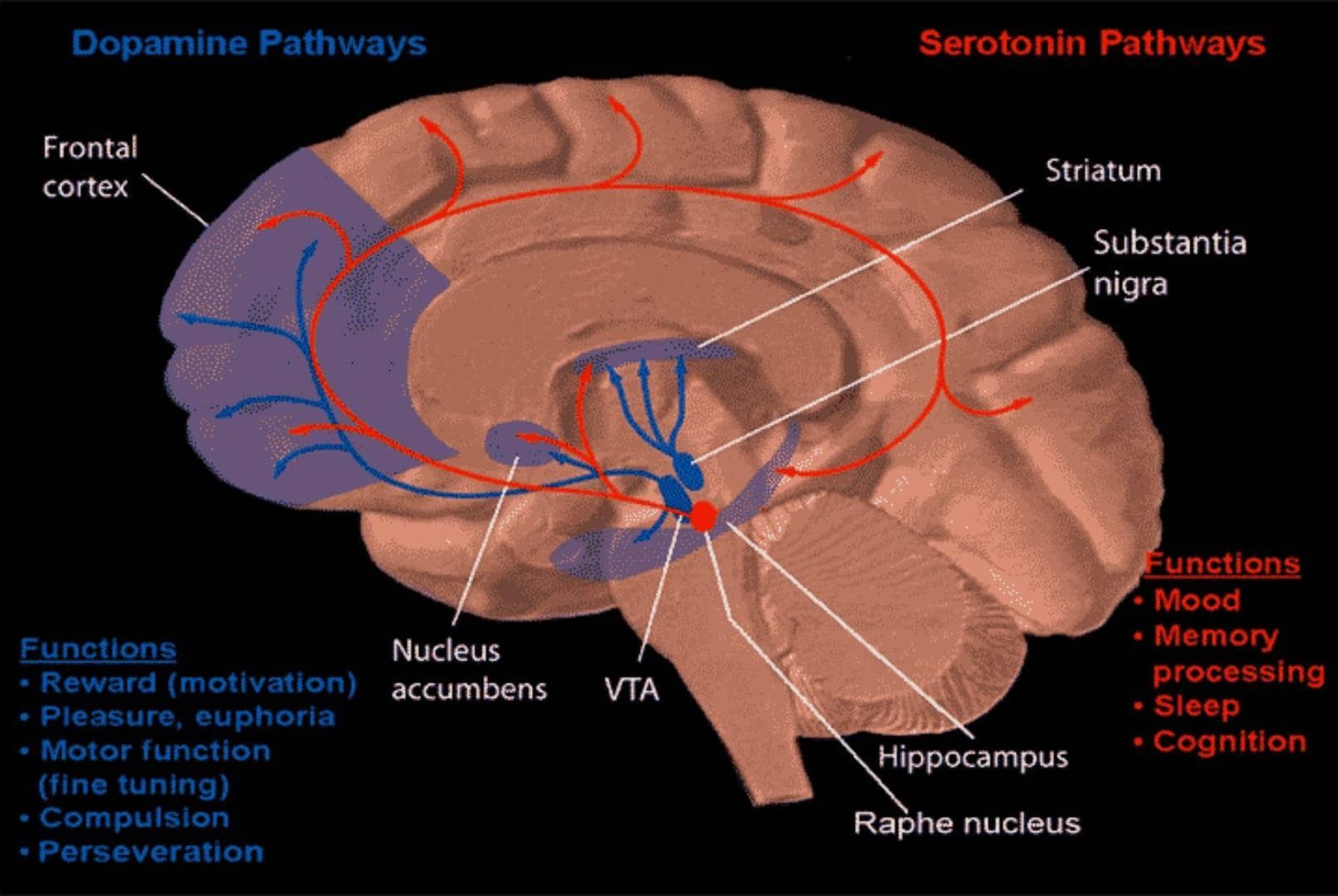
Why the disconnect? The brain has a limited metabolic energy budget and cannot run high-intensity thinking and deep body awareness simultaneously at full throttle (Raichle, 2006).
Neuroscience reveals that the brain networks responsible for outward-focused thinking (the Central Executive Network) and internal body monitoring are often “anti-correlated” (Fox et al., 2005). This means when you spend your days locked in high-level mental activity, the brain actively suppresses activity in the body-sensing regions to conserve energy for thinking (Seeley et al., 2007).
You tilt the seesaw completely toward cognition, treating the body’s signals as mere distraction. The thinking brain is shouting commands, but the lines to the body have been cut to save power.
Aligned Intervention (Why Affirmations Fail)
This explains why techniques like the Law of Attraction or positive affirmations seem fickle. It’s not so much about the technique we use; it’s about “aligned intervention.”
Affirmation, remembering a wonderful memory, or visualizing a fantastic place to improve well-being are not bad techniques. Neuroscientifically, these are called top-down regulation strategies. They use high-level thought to influence emotion.
But if they don’t work, it’s because the intention for change is not matching our body’s current state of neuroception—how safe or threatened our nervous system subconsciously feels right now.
If your body feels unsafe, a top-down command feels like a lie.
And sometimes a technique that worked yesterday doesn’t work today. Why? Because our physiology is not a static sculpture; it is a dynamic, living river.
Our nervous systems are in a constant state of flux, actively and continuously adjusting to internal states and external demands—a biological process known as allostasis (Sterling & Eyer, 1988). Furthermore, based on subconscious scans for safety or danger, our autonomic state shifts continuously throughout the day between modes of social connection, mobilization (fight/flight), or defensive shutdown (Porges, 2004).
So, the biological reality you wake up with today is literally not the same as yesterday’s. Therefore, this ever-shifting reality cannot be met by a rigid technique; it can only be met by an approach that includes the body’s reality in this present moment.
The Turning Point: From Commanding to Listening
So, how do we bridge this gap? How do we stop the micro war? Your imagination is designed to meet this challenge, but it requires a different neural pathway. Within the brain’s top-down executive functions also lies the powerful capability for directed attention.
Instead of using this attention to concentrate on good intentions for changing a current state, or thinking of what technique to use, stop. Use your directed attention to feel your body. In neuroscience, this crucial shift—turning attention inward to perceive visceral sensations from the body—is called interoception. Key brain areas, like the insula, work to bridge bodily signals into our awareness.
Tending the Soil
This interoceptive awareness is such rich soil for imagination to rise from. We have to move from instructing ourselves to feel calm, to showing our nervous system what safety feels like.
When we shift from cognitive commanding to interoceptive listening, we stop triggering the body’s threat response. We stop the war. Before you try to plant a new seed of positive imagery, tend the soil. Stop instructing. Use your attention simply to meet the reality of your body right now—the tightness, the heat, the numbness—without trying to fix it. Say to it silently: “I see you.”
When the body finally feels met, the nervous system begins to regulate naturally. And from that rich, contented soil, true imagination and healing can finally emerge.
The Real Shift: Meeting the Body Where It Is (Bottom-Up)
So, how do we use this imaginal realm correctly? We don’t use it to escape reality; we use it to communicate safety within the current reality.
We have to stop instructing and start connecting. This is the essence of a “bottom-up” approach.
Step 1: Acknowledge the Current State (without trying to fix it yet) Before you try to visualize calm, you must first internally acknowledge the stress. You have to meet your body where it is right now.
If your stomach is in knots, don’t immediately try to untie them with a picture of a beach. First, just notice the knot. Can you use your inner imagery to just sit next to that knot?
-
Example: “Okay, I feel a tight, cold stone in my stomach right now. I see it. I’m just going to breathe around it for a moment and let it know I see it.”
This sounds counterintuitive, but by acknowledging the sensation without attacking it, you stop the internal war. You are sending the first signal of safety: “I am listening.”
Step 2: Introducing “Micro-Doses” of Sensory Safety Once you have acknowledged the current state, you don’t try to flood the system with overwhelming positivity. You introduce tiny, manageable amounts of sensory safety alongside the stress.
We aren’t trying to trick the brain; we are trying to offer it a resource.
The Shift in Practice: Instead of visualizing a whole perfect scenario where you are confident and the stress is gone, try this: Keep feeling the tension in your shoulders (or wherever tension or other sensations manifest for you). But while you feel that, can you simultaneously imagine the sensory feeling or the sight of warm sunlight just on your hands or even on your shoulders? Can you really focus on that imaginary warmth—the texture of it, the temperature?
By holding both realities—the current stress and a small, imagined sensory anchor of safety—you are teaching your nervous system that it can experience discomfort without being in mortal danger.
You are using imagination not as a magic wand to erase feelings, but as a bridge to ferry signals of safety down to the survival brain in the only language it speaks: sensation.
Imaginative Methods with a Regulatory Effect: Further Reading
Different traditions and methods approach regulation through imagination in different ways. What they share is an understanding that inner experience interacts directly with physiology.
You can explore related approaches here:
-
Hypnosis
-
Imagination through deep breathing
-
Healing through imagination
-
CBT and third-wave imaginal techniques