
The Method
Exploring imagination as a transformative process
This page outlines the foundational process used across imaginative work as a way of orienting inner exploration.
How to work with Imagination
Starting to work with imagination is simple. It takes place inside, in thoughts, memories, and feelings. You can pick any of these as they appear in your awareness. It can be done anywhere and with almost anything that holds your attention.
You might want to begin with a feeling, a situation, a memory, a thought, or a pattern you notice in yourself. The moment you choose to stay with it, an inner focus is formed. From there, images, scenes, or impressions often arise on their own.
From here, imaginative work is a form of inner interaction. Thoughts and memories carry sensations, images, and feelings. As you start communicating with them, they begin to come more alive. You may hear them respond, express needs, wishes, or emotions. They can start expressing what they think of you in certain situations or behaviors you do not like in yourself, and offer guidance on changes that may be needed. Questions can be asked. Shifts can be noticed. The process unfolds through contact rather than control.
The Inquiry – In Your Imagination
What follows offers a simplified way to understand how inner interaction generally unfolds across different imaginative approaches.
1. Somatic Localization (The Anchor)
Every inner pattern has a bodily expression. Work begins by locating where an emotion, tension, or reaction is felt in the body. This grounds the process in lived experience and creates a stable point of attention.
2. Figurative Differentiation (The Symbol/Metaphor)
When an inner state is given form—such as an image, texture, or shape—it becomes easier to relate to it with curiosity rather than being immersed in it. This step allows experience to be explored without overwhelm.
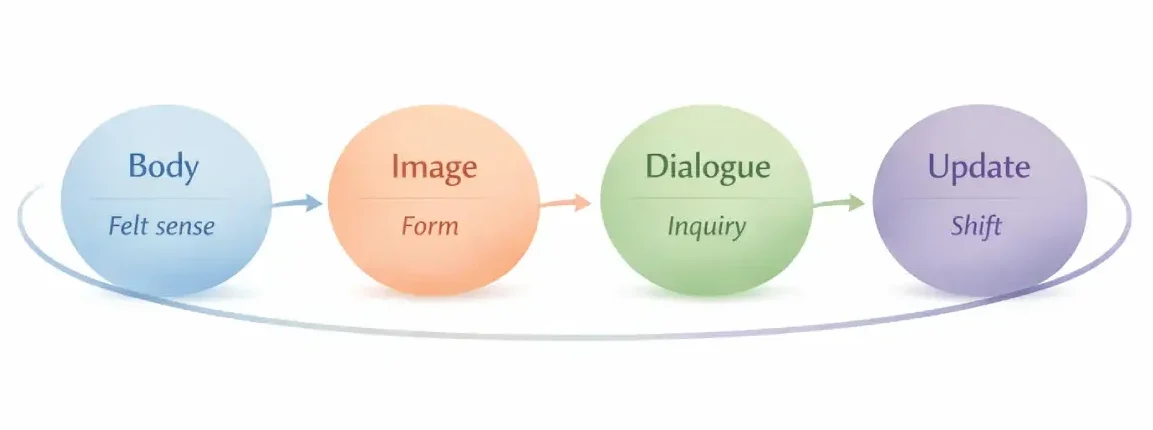
3. Dialogical Engagement
Images and inner figures often carry information that is not immediately accessible through thinking alone. Through gentle inquiry, these representations can reveal what they respond to, what they protect, or what they need. Meaning emerges through ongoing contact.
4. Experiential Update
At times, new inner experiences arise that alter how a situation or feeling is held. This may involve a sense of support, space, protection, or completion. When such experiences are embodied and relevant, they can shift how the nervous system responds.
What this kind of imagery work can support
-
Multisensory – engaging sensation, emotion, and perception
-
Relational – creating an active dialogue with inner experience
-
Grounded – rooted in what is felt, not what is imagined abstractly
This framework can support regulation, integration, learning, and deeper reorganization of emotional patterns.