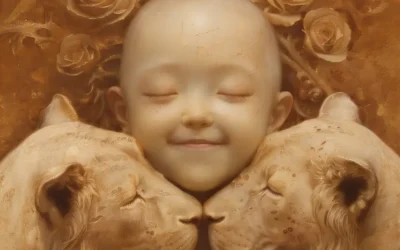

Imagine sitting on a train, your body moving through the landscape, while your attention quietly enters a meeting that has not yet happened. You hear voices, sense the atmosphere, feel a tightening or anticipation in your chest. For a few moments, the outer world fades. You are still on the train — yet you are also inside an inner scene.
This movement happens effortlessly. Attention shifts. The body responds. Meaning takes shape.
This is imagination in action.
And it is happening constantly.
The question this article explores:
How do we even know we are thinking without the imaginative function? What is the difference between ordinary thinking, analyzing a task, planning the grocery shopping, remembering a dream, daydreaming, fantasizing, ruminating?
What Is Imagination? A Multisensory, Embodied Experience
Imagination is the mind’s capacity to generate internal experiences that are not directly tied to what we are currently seeing, hearing, or touching in the external world. These experiences may appear as:
-
Vivid scenes or remembered places
-
Sounds, voices, or fragments of dialogue
-
Bodily sensations and felt moods
-
Emotional tones that color the inner landscape
-
Narrative fragments, stories, or symbolic figures
Far from being “just in the head,” imagination is deeply rooted in our physiology and lived experience.
The Multisensory Reality
Despite common associations with visual pictures, imagination is rarely limited to images alone. It is typically multisensory — a phenomenon sometimes called embodied simulation (Barsalou, 2008). A remembered moment may carry:
-
The warmth of sunlight on the skin
-
The tone of a voice
-
The specific pressure of a room’s atmosphere
The inner experience is not separate from the body that experiences it; it is a holistic re-creation of a state of being.
The Brain’s Simulation System
Psychological research understands imagination as part of the brain’s “proactive” simulation systems. When we imagine an event, the brain activates many of the same neural networks involved in actual perception and action (Barsalou, 2008).
The visual cortex, somatosensory regions, emotional circuits, and memory systems collaborate to generate an internally experienced scene. Because the brain uses the same pathways for imagination as for real-life experience, the nervous system often reacts to an inner scene as if it were happening in real time (Kosslyn et al., 2001).
Key insight: The same neural pathways are engaged whether we perceive something or imagine it. The nervous system responds as if the event were happening.
The Constant Function: Imagination in Everyday Life
Imagination accompanies us constantly — in memory, worry, anticipation, planning, and reflection. It is present when we daydream, when we replay conversations, when we sense the future before it arrives. Long before anything is analyzed or verbalized, experience is already being shaped from within.
How Imagination Appears in Everyday Experience
-
Memory — Recalling a conversation: Imagination re-creates sensory details, emotional tone, and atmosphere.
-
Worry — Anticipating a difficult meeting: Imagination generates vivid scenarios with threat bias.
-
Planning — Organizing a project: Imagination simulates steps, outcomes, and possible obstacles.
-
Reflection — Reviewing a past event: Imagination replays with new perspective or emotional tone.
-
Daydreaming — Spontaneous mental drift: Imagination unfolds without deliberate direction.
-
Fantasy — Imagining a different life: Imagination explores desire, wish, or symbolic meaning.
-
Thinking Itself — Analysis and problem-solving: Imagination provides the “screen” — the sensory-emotional texture of thought.
The Key Insight: The “Screen” of Inner Experience
How do we know we are thinking without imagination?
Imagination sets up the screen of the inner movie — it gives color, tone, shape, and form to all mental content. Without the sensory-emotional texture that imagination provides:
-
Thinking would be abstract and unfelt
-
Memories would be dry facts without emotional resonance
-
Plans would lack the felt sense of what they might be like
-
Worries would have no visceral grip
Imagination is not just one mental function among many — it is the medium through which all inner experience becomes visible and felt.
Imagination Takes Many Forms
For this reason, imagination does not express itself in only one way. It takes many forms.
-
It can appear as inventiveness — highlighting its productive and creative aspect. This is the imagination that generates new ideas, solutions, and artistic expressions.
-
It can take the shape of experiences that feel unreal or detached from shared external circumstances — the fantasies, daydreams, and inner worlds that exist alongside everyday reality.
-
It can contribute to misinterpretations or beliefs that later turn out to be inaccurate — the stories we tell ourselves about situations, people, or ourselves that may not match external reality.
-
It operates in fiction and storytelling — shaping meaning through narrative, symbol, and play. Stories are not escape from reality; they are a primary way we make sense of it.
-
It is present in dreaming — in night dreams, daydreams, and imagined futures — each with their own structure and emotional logic. Dreams are not random; they are imagination working in a different mode.
Seen in this light, imagination is not a single capacity with one tone. It is a continuous organizing activity expressed across many modes of experience.
Key insight: Imagination is not just one thing. It is the underlying capacity that expresses itself through creativity, fantasy, storytelling, dreaming, and even misinterpretation. Understanding this helps us recognize it in all its forms — not just the ones we value or notice.
Why It Carries Force: The Biological Reality
Inner experience carries power because the nervous system responds to it directly. Research shows that similar neural systems engage when we perceive something, remember it, or imagine it (Kosslyn et al., 2001). Inner scenes, sensations, and emotional tones activate the body as if they were happening now.
The Physiological Impact
-
A recalled memory can tighten the throat or quicken the pulse
-
A future scenario can generate dread or relief before anything has occurred
-
Inner scenes can feel immersive, persuasive, and difficult to step out of — especially under stress or emotional load
This is why a remembered conflict may raise cortisol levels, while an imagined safe place can activate the parasympathetic nervous system, lowering heart rate and blood pressure (Holmes & Mathews, 2010).
The body responds not only to external events but also to internally generated experiences. The brain continuously simulates possibilities, and these simulations are not neutral — they carry affect, expectation, and meaning. For the nervous system, inner and outer experience are deeply intertwined.
The Three Dimensions of Imagination
Imagination occupies a unique position in human experience, bridging three dimensions that together shape how it operates and what it can do. Any inner experience has a biological basis, a somatic texture, and a symbolic resonance. These three operate simultaneously in every moment of imaginative experience.
Understanding these three dimensions is essential for understanding how imagination works — and, as we will see in later articles, how it can enable change.
The Biological Dimension
Imagination arises from specific brain systems that generate and respond to internal representations. This is the neural machinery of imagination.
The Brain’s Simulation Systems
When we imagine an event, the brain activates many of the same neural networks involved in actual perception and action (Barsalou, 2008). The key systems include:
-
Visual Cortex — Generates visual aspects of inner experience
-
Somatosensory Regions — Creates the felt sense of the body in the imagined scene
-
Limbic System — Adds emotional salience; determines which experiences feel “important”
-
Insula — Integrates interoceptive signals from the viscera; influences the “felt quality”
-
Motor Cortex — Engages during imagined movement
-
Default Mode Network (DMN) — Generates autobiographical memory and internal simulations of the future
Why This Matters
Because the brain uses the same pathways for imagination as for real-life experience, the nervous system often reacts to an inner scene as if it were happening in real time (Kosslyn et al., 2001). This is why:
-
The amygdala activates in response to imagined threat (Ochsner & Gross, 2005)
-
The motor cortex engages during imagined movement
-
The body prepares for action even when the event is only imagined
Imagination is not a ghost in the machine — it is a biological event.
The Somatic Dimension
Imagination carries bodily states and felt senses that color and give weight to inner experience. A memory does not arrive as a dry fact; it arrives with a posture, a tension, a quality of breath. These somatic markers shape how the experience feels and what it means.
The Felt Sense
The body is not merely a passive receiver of inner experiences — it participates in their formation. The felt sense of an imagined scene provides direct information about the state of the organism:
-
Does the experience feel like it contracts or expands?
-
Does it feel warm or chill?
-
Is there tension or release in the body?
-
What is the quality of breath?
Accessing the Autonomic Nervous System
This somatic dimension is why work with imagination can access the autonomic nervous system directly. When we engage with inner experience, we are not just thinking — we are feeling. And these feelings are not abstract; they are the body’s responses to internal representations.
-
A remembered conflict may tighten the chest
-
An imagined safe place may slow the breath
-
A worrying scenario may quicken the pulse
The body responds to imagined experiences as if they were real because, for the nervous system, they are.
The Symbolic Dimension
Inner experiences carry deeper meanings and metaphors for the individual’s life narrative. A figure in a dream, a recurring inner scene, a felt sense of pressure in the chest — these are not random. They condense psychological material into symbolic form.
What Symbols Carry
-
Personal history — Unique life experiences shape the experience’s meaning
-
Cultural inheritance — Shared symbols, archetypes, and narratives
-
Unconscious material — What has not yet become conscious appears in symbolic form
-
Emotional content — The experience carries the affect associated with the material
Working Symbolically
Working with imagination symbolically means attending to what the experience expresses, not just what it depicts. This is different from interpreting from the outside. Instead, it means:
-
Allowing the inner experience to speak in its own language
-
Exploring the associations and meanings that arise
-
Noticing how the experience shifts as its meaning is engaged
The Door to Meaning-Making
The symbolic dimension opens the door to:
-
Meaning-making — Understanding what the experience reveals about one’s inner world
-
Narrative repair — Changing the story the experience tells
-
Reorganization of self-understanding — New meanings lead to new ways of being
The Three Dimensions Operate Simultaneously
This is the key insight: Any inner experience has a biological basis, a somatic texture, and a symbolic resonance. These are not separate layers; they are simultaneous aspects of the same experience.
-
Biological — The neural machinery: the experience is real, not “just in your head”
-
Somatic — The bodily felt sense: the experience carries weight and force
-
Symbolic — The meaning and narrative: the experience connects to personal story and identity
A single inner experience is simultaneously:
-
A biological event in the brain
-
A somatic experience in the body
-
A symbolic expression of meaning
The Nervous System and the Autonomic Filter
The experiences that appear in the mind are not independent of the body’s physiological state. The nervous system continuously shapes the emotional tone, intensity, and content of inner experience.
How Nervous System State Shapes Inner Experience
When the nervous system is in sympathetic arousal (stress, threat):
-
Inner experience becomes vivid and urgent
-
It is threat-biased and difficult to disengage from
-
It tends to be repetitive, with worst-case scenarios
When the nervous system is in parasympathetic/safety state (rest, connection):
-
Inner experience becomes slower and more exploratory
-
It is symbolic, associative, creative, and flexible
-
It is expansive rather than contracting
This shift reflects the interaction between emotional salience systems in the limbic brain and the autonomic regulation of arousal (LeDoux, 2012; Damasio, 1994). The same inner content can feel completely different depending on whether we are stressed or at ease.
Trauma and the Bias Toward Vigilance
Traumatic experiences can deeply scar this internal landscape. When threat responses are not fully resolved, the nervous system may remain biased toward a state of chronic vigilance. In such conditions, inner experience often becomes repetitive, intrusive, and fragmented.
Researchers studying emotional memory have observed that these reactions involve both memory networks and autonomic regulation systems (LeDoux, 2012). The body is not merely recalling a past event; it may partially re-enter the physiological state associated with it, causing sensations, emotions, and inner scenes to feel vividly present.
Somatic Tracking
For this reason, trauma-informed therapeutic approaches prioritize the nervous system when working with inner experience. Rather than engaging with inner content purely through intellectual interpretation, these methods use somatic tracking — monitoring breathing, muscle tension, and heart rate while the experience is present (Levine, 1997).
When the nervous system begins to settle through regulation, the associated inner experience often changes spontaneously. Scenes become less rigid, new perspectives appear, and the emotional “charge” softens. The transformation of inner experience is therefore not only a cognitive process but a physiological one.
Conclusion: Recognizing What Is Already There
Imagination is already active in every life. It is not a special capacity we occasionally use; it is the constant medium through which all inner experience takes form.
The key insight:
We do not need to “create” imagination — we need to recognize it. The task is not to learn how to imagine but to become aware of the imagination that is already happening, constantly, in every moment of inner life.
The three dimensions — biological, somatic, and symbolic — are not abstract concepts. They are the living reality of every inner experience, every memory, every anticipation, every thought.
Once we recognize this, we can begin to work with imagination deliberately.
Key References for Article 1
-
Barsalou, L. W. (2008). Grounded cognition. Annual Review of Psychology, 59, 617-645.
-
Damasio, A. R. (1994). Descartes’ Error: Emotion, Reason, and the Human Brain. Putnam.
-
Holmes, E. A., & Mathews, A. (2010). Mental imagery in emotion and emotional disorders. Clinical Psychology Review, 30(3), 349-362.
-
Kosslyn, S. M., Ganis, G., & Thompson, W. L. (2001). Neural foundations of imagery. Nature Reviews Neuroscience, 2(9), 635-642.
-
LeDoux, J. (2012). Rethinking the emotional brain. Neuron, 73(4), 653-676.
-
Levine, P. A. (1997). Waking the Tiger: Healing Trauma. North Atlantic Books.
-
Ochsner, K. N., & Gross, J. J. (2005). The cognitive control of emotion. Trends in Cognitive Sciences, 9(5), 242-249.